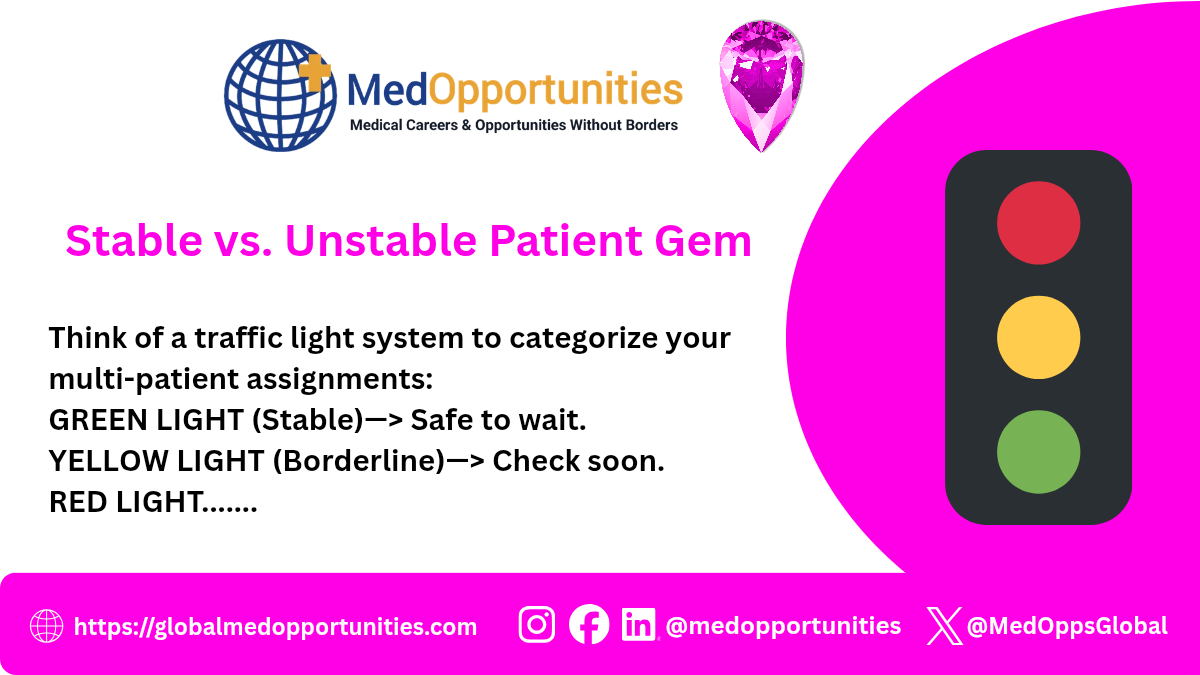
1. Rapid Summary
Priority nursing action questions test your ability to make safe, logical clinical judgments when managing a deteriorating client or handling competing demands. The NCLEX requires you to determine what to do first, next, or most immediately. To excel, you must look past your instincts and systematically apply validated triage frameworks: Airway-Breathing-Circulation (ABCs), Maslow’s Hierarchy of Needs, and Nursing Process (Assessment vs. Implementation).
2. High-Yield Points/Must Know
| Priority Framework | Core Clinical Rules & Rationales |
|---|---|
| ABC Framework | Airway always wins. A patent airway is the absolute prerequisite for life. Breathing (ventilation/oxygenation) is second, followed by Circulation (perfusion/bleeding control). |
| Assessment vs. Action | Always assess before implementing an action, unless an immediate, life-threatening emergency is already fully established (e.g., a client is in ventricular fibrillation). |
| Acute vs. Chronic | Prioritize acute, sudden, or unstable physiological changes over chronic, predictable, or long-standing medical diagnoses. |
| Systemic vs. Local | Prioritize systemic, widespread issues (e.g., anaphylaxis, shock) over localized, isolated symptoms (e.g., a broken finger, a localized skin rash). |
3. Mnemonics
Remember the P-A-S-S prioritization checklist when evaluating multiple answer options:
- P - Physiological over Psychological: Address physical body emergencies (chest pain, hemorrhage) before psychological or social stressors (anxiety, family conflict).
- A - Assessment Check: Do I have enough data to act? If the option gathers relevant, fresh clinical data, it is often the priority.
- S - Stability Verification: Is this client's condition actively changing or predictable? Target the volatile client first.
- S - Safety & Infection Control: Implement interventions that minimize immediate physical danger or stop cross-contamination.
4. Most Tested Facts
The Ultimate Prioritization Hierarchy:
When choosing which client to see first on a multi-patient assignment, or which action to take at the bedside, use this structural waterfall:
- Airway: Stridor, choking, oral swelling, foreign body obstruction, tongue displacement.
- Breathing: Tachypnea (RR > 30), intercostal retractions, O2 saturation < 90%, asymmetric chest expansion, open pneumothorax.
- Circulation: Absent pulses, cool/clammy skin, severe hemorrhage, thready tachycardia, cap refill > 3 seconds, hypotension.
- Neurological (Disability): Sudden drop in Glasgow Coma Scale (GCS), acute change in level of consciousness (LOC), stroke symptoms, pupillary changes.
The "Assess First" Rule vs. Emergency Exceptions:
- The Standard Rule: If a client complains of an issue, your priority action is to gather more data.
Example: A client reports a new onset of pain after an orthopedic procedure.
Priority Action: Assess the pain location, quality, and neurovascular status before calling the doctor or giving a pill.
- The Emergency Exception: If the question provides an obvious, indisputable emergency, do not waste time assessing—implement life-saving actions immediately.
Example: A client's tracheostomy tube completely dislodges and flies across the room.
Priority Action: Manually ventilate the client with an Ambu bag or insert a backup tube immediately. Do not stand there assessing their respiratory rate.
5. Clinical Correlation
The nurse is working on a step-down unit and receives report on four clients. Which client must the nurse evaluate first?
- Client 1: A 54-year-old male with chronic COPD whose oxygen saturation is stable at 89% on 2L nasal cannula.
- Client 2: A 32-year-old female who had an open cholecystectomy yesterday and is reporting pain rated as an 8 out of 10.
- Client 3: A 45-year-old male admitted with a myocardial infarction who is experiencing sudden, frequent premature ventricular contractions (PVCs).
- Client 4: A 68-year-old female with a history of a stroke who has a total intake of 400 mL and an output of 100 mL over the last 8 hours.
- Wrong Assessment: Visiting Client 2 first because an 8/10 pain score sounds extreme, or Client 1 because an O2 sat of 89% is low.
- Correct Assessment: See Client 3 first. Frequent PVCs following an acute myocardial infarction indicate extreme myocardial irritability and are an acute warning sign for lethal arrhythmias like ventricular tachycardia or fibrillation. This represents a life-threatening, unstable Circulation crisis. Client 1's status is expected for chronic COPD. Client 2 is post-op pain (expected). Client 4 is a fluid balance issue that can be managed after stabilizing cardiac issues.
6. Frequently Tested
- Anaphylaxis Action Sequence: If a client exhibits signs of an acute allergic reaction (angioedema, wheezing, hives) during an infusion:
- Stop the medication/infusion immediately.
- Maintain the IV access line with normal saline.
- Assess airway status and oxygenation.
- Administer intramuscular Epinephrine as prescribed.
- The "Allergen/Poison" Rule: Your very first action when a toxic substance or allergen is actively entering a client's body is to remove or stop the exposure. Do not assess vital signs while the toxic chemical is still infusing.
- Evisceration Protocol: If a surgical abdominal wound pops open and organs protrude:
- Stay with the client and call for help.
- Place the client in a low-Fowler's position with knees bent to relax the abdominal wall.
- Cover the exposed organs with sterile dressings soaked in sterile normal saline.
- Notify the surgeon immediately; keep the client NPO for emergency surgery.
7. Common NCLEX Trap
- Trap: Choosing an option that involves calling the healthcare provider before doing anything to assist a crashing patient.
- Reality: False. The NCLEX wants to see what you, the independent professional nurse, can do for the client before picking up the phone. Position the airway, stop the offending drug, or check the pulse first, and then notify the provider.
- Trap: Prioritizing a client simply because the option mentions a scary-sounding disease name.
- Reality: False. Look past the diagnosis and evaluate the stability descriptors. A client with "chronic, stable advanced heart failure" is prioritized below a client with a "new, sudden onset of mild shortness of breath" following a broken leg (potential pulmonary embolism).
- Trap: Selecting an assessment option when the client is already exhibiting an advanced, unambiguous emergency.
- Reality: False. If a client is actively hemorrhaging from a severed artery, do not select "Assess the blood pressure." Your immediate priority action is to apply direct pressure to the wound to stop the bleed.
8. Mini Questions
Question 1: The nurse is caring for a client who is receiving their first dose of intravenous ampicillin. Ten minutes into the infusion, the client calls out and states, "My throat feels tight, and I feel itchy all over." Which action should the nurse take first?
A. Obtain a full set of vital signs, including blood pressure and temperature.
B. Administer an as-needed ordered dose of diphenhydramine.
C. Stop the ampicillin infusion immediately.
D. Notify the healthcare provider and the rapid response team.
- Answer: C
- Explanation: The client is exhibiting early signs of anaphylaxis, a life-threatening allergic reaction. The nurse's absolute first action must be to remove the offending agent by turning off the infusion pump to prevent further systemic exposure. Vital signs and notifications occur immediately afterward.
Question 2: The charge nurse is reviewing the assigned client loads on a busy medical-surgical floor. Which client requires the most immediate intervention by a nurse?
A. A client with deep vein thrombosis who is reporting sudden-onset pleuritic chest pain and shortness of breath.
B. A client with diabetes mellitus whose morning fingerstick glucose reading is 240 mg/dL.
C. A client who underwent a total gastrectomy 3 days ago and has diminished bowel sounds in all quadrants.
D. A client with chronic kidney disease whose latest serum creatinine level is 3.2 mg/dL.
- Answer: A
- Explanation: Sudden chest pain and shortness of breath in a client with a known DVT strongly signals a life-threatening pulmonary embolism (an acute Airway/Breathing/Circulation emergency). The other choices represent elevated or chronic variations that are expected for their respective disease processes and are not immediately life-threatening.
Question 3: The nurse enters a post-operative room and observes that the client's abdominal incision has eviscerated, with loops of bowel visible through the wound dressing. After calling for assistance, which action should the nurse take next?
A. Gently push the protruding bowel loops back inside the abdominal cavity using sterile gloves.
B. Cover the exposed bowel tissue with sterile dressings saturated in sterile normal saline.
C. Document the event thoroughly in the client's electronic progress notes.
D. Assist the client to stand up and walk over to an emergency stretcher.
- Answer: B
- Explanation: To prevent tissue drying, ischemia, and severe infection, an eviscerated wound must be immediately covered with sterile dressings soaked in warm, sterile normal saline. Organs should never be manually pushed back in, and the patient must remain flat and motionless.
Question 4: A client on a telemetry unit who is being monitored following an acute myocardial infarction suddenly develops ventricular fibrillation on the cardiac monitor. The nurse enters the room and confirms the client is unresponsive and pulseless. Which action is the priority?
A. Initiate a comprehensive neurological examination.
B. Call the pharmacy to deliver an intravenous amiodarone infusion.
C. Immediately apply a defibrillator and deliver a shock, or start high-quality CPR.
D. Draw an emergency panel of serum cardiac markers and electrolytes.
- Answer: C
- Explanation: Ventricular fibrillation is a lethal, pulseless rhythm requiring immediate electrical defibrillation and chest compressions. Because the emergency is fully established, no further assessment or laboratory data collection is warranted; instant resuscitation action is mandatory.
Question 5: The nurse is evaluating four clients who are calling out for assistance simultaneously. Using priority frameworks, which client should the nurse address first?
A. A client with an arm cast who states, "My fingers are completely numb, cold, and turning blue."
B. A client who is requesting their scheduled pain medication for a chronic migraine.
C. A client who is demanding to speak with the hospital administrator regarding cold food.
D. A client with an indwelling urinary catheter who reports feeling a strong urge to urinate.
- Answer: A
- Explanation: Blue, cold, and numb fingers under a cast indicate acute compartment syndrome, which causes rapid ischemia, nerve damage, and loss of the limb if surgical decompression (fasciotomy) is delayed. This represents an unstable, severe Circulation crisis taking absolute priority over pain, mechanical catheter discomfort, or administrative complaints.
9. Key Takeaway Box
Key Takeaway: For NCLEX priority questions, let the ABCs guide you: Airway > Breathing > Circulation. Always choose the client who is acute, sudden, or unstable over those with chronic, predictable conditions. Remember the golden rule: Assess before you implement, unless an immediate lethal emergency is staring you in the face. If a toxic drug or allergen is infusing, your very first move is always to stop the infusion!